

Blog
Moving House with Pets: A Practical Dorset Guide (2026)

Planning on moving house with pets in Dorset this year?
If so, your dog has probably already worked out that something is going on. The boxes have appeared in the hallway, the daily walk is running late, and the suitcases have come down from the loft.
Cats are often even quicker to pick up on it, and most respond by quietly vanishing under the nearest bed.
The good news is that a little forward planning makes an enormous difference.
At R.H. Pardy Moving & Storage, we have been moving Dorset households since 1924, and a great many of those households came with paws, feathers or fins attached.
Over a century, we have learned that the calmest pet moves have very little to do with luck and a great deal to do with timing, paperwork and knowing your new neighbourhood before you arrive.
In this guide, we take a fresh look at moving house with pets Dorset style, covering recent rule changes, a realistic countdown to moving day, and the local quirks of our beaches, heaths, and New Forest grazing land that every new arrival should know.
A Short Overview of This Blog
This guide gives Dorset pet owners a simple route to a calm, well-planned move in 2026. Here is what each section covers.
- The Pet Paperwork That Changed Recently, microchips, new renting rights, and backyard hen registration.
- A Four Week Countdown, what to sort for your pets in the weeks before the move.
- Moving Day, keeping pet’s safe and settled while the removals team works.
- Cats, Rabbits, Fish and Feathered Friends, quick tips for each type of pet.
- Learning Your New Dorset Patch, beach rules, heathland, adders, and New Forest livestock.
- Pet Relocation Bournemouth, how R.H. Pardy plans a removal around your animals.
- A Happy New Home for Everyone, a final word on settling in.
- Frequently Asked Questions, answers to the removals questions pet owners ask us most.
Follow the steps in order, and your pets should settle into their new Dorset home much faster than you might expect.
Before You Pack: The Pet Paperwork That Changed Recently

It is easy to think of pet preparation as a moving-day job, but some of the most important tasks are legal, and a few are newer than many owners realise.
Microchips now cover cats as well as dogs.
Every dog must be microchipped and registered by eight weeks old, and in England cats must be chipped and registered by 20 weeks, even if they never set foot outside.
According to the government guidance on microchipping your dog or cat, you are responsible for keeping the database details current when you move house, and owners can be fined up to £500 if a pet is not chipped or registered properly.
Dogs must also wear a collar and tag showing your name and address in public, so order the new tag before moving day, not after.
Renting with pets is far easier than it used to be.
If your move takes you into a rented home in Bournemouth, Poole or Christchurch, the Renters’ Rights Act came into force on 1 May 2026.
Tenants can now ask in writing to keep a pet; landlords must reply within 28 days, and a blanket “no pets” clause no longer works on its own.
Woodgreen Pets Charity has a clear guide to renting with pets under the new law, and our advice is simple: make the request before you sign so there are no surprises later.
Backyard hens need registering too.
This is the one that catches people out.
Anyone in England keeping poultry, even a couple of garden hens, must register as a bird keeper with APHA within one month of keeping birds at a premises, and must tell APHA within 30 days if their details change.
Moving your flock from Ferndown to Verwood counts. Budgies, canaries, and parrots kept entirely indoors are exempt.
A Four-Week Countdown for Moving House with Pets in Dorset
Four weeks out.
Find a vet near your new home now rather than in an emergency.
The Royal College of Veterinary Surgeons has a Find a Vet search tool, and once you have chosen a practice, ask your current vet to transfer the records across.
It is also a good time to top up flea, tick, and worming treatments, because Dorset’s heaths and woodland are prime tick territory.
If you plan to use kennels or a cattery on the day, book now, as summer moves often coincide with the busiest holiday weeks.
This is also when we carry out your free removals survey. Many customers with nervous pets choose our video survey, which you complete on a smartphone, so no stranger walks from room to room and unsettles the household.
Two weeks out.
Cats Protection suggests choosing a quiet “safe room” in both your current home and your new one, then feeding your cat in that room so it already feels familiar.
Their advice on moving house with a cat is the best we have read. For dogs, keep walks and mealtimes exactly as they are, and leave the travel crate or cat carrier out with a blanket inside so it becomes part of the furniture rather than a sign that something unpleasant is coming.
The final week.
Pack a pet overnight bag with food, bowls, bedding, a lead, poo bags, litter, medication, your vet’s details, and a favourite toy.
This bag travels in your car, not on the removal vehicle. If you would like more structure for the rest of the household, our moving house checklist works neatly alongside this countdown.
Moving Day: Keeping Paws Clear of the Removals Team
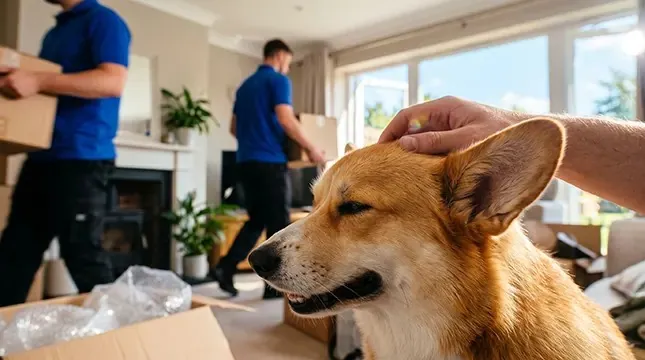
On the day itself, the biggest risk to any pet is an open door. Removals crews are in and out constantly, and even the most sensible dog can make a dash for it when routine goes out of the window.
Settle your pets into the safe room before our team arrives, close the door and stick a clear note on it. Our crew will simply work around that room and load it last.
Pets should always travel with you in your own car, as removal vehicles are not designed or covered to carry animals.
On warmer days, never leave a pet waiting in a parked car while you pop back for one more box.
When you arrive, set up the safe room at the new house first, with bedding, water and something that smells of home before the rest of the furniture comes off the vehicle.
Then walk the garden. New gardens can hide gaps under fences, open ponds and plants that are toxic to pets, so give everything the once-over before letting a dog explore on its own.
For more dog-specific ideas, our earlier article on moving house with a dog covers routine and settling in tips in more detail.
Cats, Rabbits, Fish and Feathered Friends

Of course, it is not all about dogs and here is some practical advice for other animals:
Cats. Keep cats indoors for at least three weeks so they can learn that the new house is home and spread their scent around it. When the time comes, let them out just before a meal, early in the day, and leave the door open behind them. If your move is a short hop, say from Highcliffe to Mudeford, a confident cat may try to head back to the old address, so it is worth asking the new occupants not to feed or encourage them.
Rabbits and guinea pigs. Keep bonded pairs together at all times, travel them in a well-ventilated carrier and avoid the hottest part of the day. Load the hutch last and set it up first so they spend as little time as possible out of their territory.
Fish and reptiles. Fish can travel in sealed bags of their own tank water inside an insulated box, and keeping the filter media damp helps the tank settle again quickly. Reptiles need their temperature controlled throughout the journey, so speak to your vet or specialist supplier before moving day.
Hens. Move hens in ventilated crates, keep them shut in for a few days so they learn where home is, and remember that APHA registration needs updating.
Learning Your New Dorset Patch with Four Legs
Dorset is a wonderful county for pets, but it does have its own rules, and they vary depending on where you settle.
Beaches. Across Bournemouth, Christchurch and Poole, dogs are welcome on every beach from 1 October to 30 April. From 1 May to 30 September, they are not allowed on any Blue Flag or Seaside Award beach. The good news is that BCP Council lists several spots where you can walk your dog all year round, including:
- Hengistbury Head
- Mudeford Sandbank and Gundimore Beach
- Friars Cliff, between the wave wall and Groyne H4
- Hamworthy Beach
- The western end of Sandbanks promenade to Haven Point by the chain ferry
The full list and downloadable maps are on the council’s dogs on beaches page.
Heathland. Much of the area around Ferndown, Verwood and St Leonards is precious heath. At Avon Heath Country Park, for example, all dogs must be on a short lead from 1 March to 31 July to protect ground-nesting birds and breeding reptiles, and British White cattle graze the site.
You can read the Avon Heath dog walking rules before your first visit.
Adders live on the heaths too, and while Dorset Dogs explains that adder bites are rarely fatal but must be treated by a vet, keeping to the paths is the easiest way to avoid one.
The New Forest. If you are moving towards Ringwood, Bransgore, New Milton or Lymington, your dog will soon meet free-roaming ponies and cattle.
The New Forest Dog Walking Code asks owners to keep their distance from grazing animals, let go of the lead if chased by cattle, and stay on the main tracks while birds’ nests are on the ground.
Our New Forest removals team knows these villages well and is always happy to share local tips.
Pet Relocation Bournemouth: How R.H. Pardy Helps Pet Owners Move
Removal companies do not transport animals of any kind however, at R H Pardy, we do take them into consideration when we are helping you to plan your move. When we survey your home, we will ask about your pets and your arrangements for them.
Our professional packing service is particularly popular with pet owners because it keeps the chaos of boxes to a day or two rather than several weeks of upheaval, and we can supply specialist cartons and temporary pet carriers.
If your completion dates do not line up, our secure storage service in Christchurch can hold your furniture while you settle the animals into a rental or stay with family.
Whether you need our Bournemouth removals team for a local move or our house removals service for a longer journey, you will be working with a British Association of Removers member that has been looking after Dorset families, and their pets, for over a hundred years.
That is why so many local owners turn to us for pet relocation Bournemouth advice as well as the move itself.
You can get in touch here to book a free survey or simply ask a question.
A Happy New Home for Everyone
Moving house with pets in Dorset does not have to be stressful.
Sort the paperwork early, keep routines steady, give each animal a quiet, safe room on the day, and take a little time to learn the local beach and heathland rules.
Do that, and the whole family, four-legged members included, will be curled up and settled in your new home before you know it.
Book a survey on 01425 508267 or 01202 152120, weekdays 9am to 5pm, or use the form. Email sales@pardyremovals.com.