




Planning your dream move and looking for European removals from Dorset?
There is a particular kind of excitement that comes with deciding to leave Dorset behind, at least the day-to-day version of it, and head across the Channel to start a new chapter somewhere in Europe.
Whether your sights are set on the sunlit terraces of southern Spain, the rolling vineyards of the Dordogne, or a quiet corner of Portugal, the dream tends to be vivid and the practicalities, shall we say, rather less so.
That is where this guide comes in.
We want to walk you through exactly what a European removal from Dorset actually involves in 2026: how long it takes, what paperwork you will be dealing with, what it is likely to cost, and how the whole process works from start to finish.
No jargon, no vague reassurances, just a clear and honest picture to help you plan with confidence.
Let us see if we can ger your journey to Europe started.
European Removals from Dorset: What to Expect in 2026
This quick guide breaks down timelines, costs, paperwork, and logistics so you can plan with clarity and avoid surprises when you move to Europe.
- Why Moving from Dorset to Europe Is Different Now
Post-Brexit rules mean more paperwork and planning, but Dorset’s proximity to ports like Poole and Southampton still makes European relocations efficient. - How the Process Works (Start to Finish)
From survey and quote to packing, customs clearance, and delivery, understanding each stage helps you stay in control of your move. - Realistic Timelines for European Removals
Dedicated services can take just a few days, while groupage may take weeks—your timeline depends on distance, service type, and customs delays. - Essential Paperwork You Will Need
Inventory lists, Transfer of Residence (ToR) relief, proof of address, and ID are key to avoiding delays and unexpected charges. - Costs Explained Clearly
Prices vary widely based on volume, distance, and service type, with additional costs like insurance, storage, and packing often overlooked. - Dedicated vs Groupage Services
Faster, premium dedicated transport versus slower, cost-effective shared loads—choosing the right option depends on budget and urgency. - Packing for a European Move
International transport demands stronger packing, careful preparation, and awareness of restricted items to protect your belongings. - Storage Solutions When Dates Don’t Align
Flexible storage options in the UK or abroad can bridge gaps between move-out and move-in dates without added stress. - Popular European Destinations from Dorset
France, Spain, and Portugal lead the way, each offering different lifestyles, costs, and relocation requirements. - Why Choosing a BAR-Registered Company Matters
Accreditation ensures professional standards, financial protection, and expertise in handling complex international moves. - Planning Your Move with a Trusted Dorset Removals Company
Working with experienced local specialists simplifies the process, ensuring your move is handled efficiently from start to finish.
Why Moving from Dorset to Europe is a Bit Different Now

It is worth being upfront: moving abroad from the UK looks quite different today than it did before Brexit.
Free movement no longer applies, which means the process involves more planning, more paperwork, and a little more patience than it once did.
That said, thousands of people successfully relocate from the UK to Europe every year, and with the right preparation, it is absolutely manageable.
The good news is that Dorset sits in a genuinely convenient spot for European removals.
The proximity of ports at Poole and Southampton means your belongings are not being hauled across the length of the country before they even reach the coast.
A good removal company will be well-versed in navigating the post-Brexit logistics, which makes choosing the right partner all the more important.
If you are in the early stages of planning, it helps to have a general sense of what each EU country requires of incoming residents.
The Global Citizen Solutions guide to moving from the UK to Europe gives a solid country-by-country breakdown of visas, residency, and customs rules.
How the Whole Thing Actually Works: From Survey to Delivery

It helps to understand the broad shape of a European removal before you dive into the details.
The journey typically starts with a home survey, either in person or via video, so your removal company can accurately assess the volume of your belongings.
This is not just about producing a quote; it also helps determine the right vehicle size, whether shared or dedicated container options are more suitable, and which route makes the most practical sense.
Once you have agreed a date and signed the contract, the packing phase begins.
Most reputable companies offer a full professional packing service, which is vital for a move to Europe.
Your belongings are carefully wrapped, inventoried, and loaded, and customs documentation is prepared.
The vehicle then travels to a departure port, crosses the Channel, clears customs at both ends, and arrives at your new door.
The Pardy Moving & Storage European Removals service covers all the major destinations across the continent, with experienced crews who understand what a cross-border move actually requires on the ground.
Realistic Timelines: How Long Will It Take?

One of the most common questions people ask is how long a European removal actually takes from start to finish.
This is a difficult question to answer with certainty. Timelines depend on a few key variables: your destination, the volume of your move, whether you choose a dedicated or groupage service, and how smoothly customs clearance goes at either end.
As a rough guide, a dedicated vehicle service to France, Spain, or Portugal from Dorset typically takes between three and seven days door-to-door.
Italy, Germany, or the Netherlands might add a day or two, depending on routing.
Groupage services, where your belongings share a vehicle with other customers headed in a similar direction, can take two to four weeks but often cost considerably less.
Factor in time at either end for customs processing and unforeseen delays, which occasionally happen, particularly if documentation is incomplete or there are some traffic issues, so building a buffer into your timeline is always sensible.
Arriving at your destination a few days before your belongings generally makes sense, even if it means sleeping on a camp bed for a night or two.
The Paperwork: What You Actually Need to Get Ready

This is the part that tends to make people slightly nervous, and understandably so.
The post-Brexit customs framework means there is more documentation involved than before. But it is far less daunting than it sounds once you know what you are dealing with.
The starting point for most moves is a detailed inventory of everything you are transporting.
This needs to be itemised and valued, not necessarily down to the last teaspoon, but comprehensive enough to satisfy customs at the destination country.
Your removal company will guide you through the format required.
For most EU destinations, you will need to apply for what is commonly referred to as Transfer of Residence (ToR) relief.
This is the mechanism through which you can bring your personal belongings into the destination country without paying import duty or VAT, provided you meet the qualifying criteria.
Which broadly speaking, means that you need to have owned the goods for more than six months prior to shipment and be making a permanent move to Europe.
Each EU country administers its own version of this relief, so the exact process varies by destination.
The FrenchEntree guide on customs and VAT for UK to France removals is a helpful example of how one country handles the process in practice, and a useful template for understanding what other EU nations tend to require.
You will also need a valid passport, proof of your new address in the destination country (a rental agreement or property purchase document works well), and evidence of your previous UK residence.
In some cases, a job contract or registration with local authorities may also be asked for.
Your international removals specialist should be able to provide a tailored checklist for your specific destination.
What It Costs: A Straightforward Look at the Numbers

Cost is, of course, a significant factor for anyone planning to relocate to Europe, and it is one where transparency matters.
The price of a European removal from Dorset will vary depending on the volume of your possessions, the distance to your destination, the service type you choose, and the time of year.
As a very general ballpark figure, a full-house removal from Dorset to France or Spain on a dedicated vehicle might sit anywhere between £3,000 and £8,000 for a typical three-bedroom property.
Larger homes or more distant destinations will naturally attract higher quotes.
Groupage services can sometimes bring costs down quite a bit if your timeline is flexible enough to accommodate a shared load.
It is worth noting that the quoted removal price is rarely the only cost involved; it is just one part of the equation.
You will want to factor in removals protection; most reputable movers will discuss this with you, which is essential for any cross-border move.
Storage at either end is another potential cost, particularly if your move date does not align neatly with a property completion or tenancy start. Perhaps you simply need time to find the right home for you. Temporary storage works very well in these circumstances; however, there is a cost attached.
Packing materials are sometimes included in full-service quotes and sometimes priced separately.
Check carefully. The Pardy packing services page gives a good sense of what professional packing actually covers and why it is often money well spent when calculating the cost of European removals.
Dedicated Vehicle vs Groupage: Choosing the Right Option for You

This is a decision that comes up in almost every European removal conversation, so it is worth spending a moment on it.
A dedicated vehicle means the lorry carries only your belongings from Dorset to your destination.
It is faster, more straightforward from a customs perspective, and gives you more control over the schedule. It is also the more expensive option.
Groupage, sometimes called a shared or part load service, places your possessions alongside those of other customers whose goods are travelling in the same general direction.
Your things are allocated space within a larger vehicle or container, and the journey takes longer because the load is assembled and distributed across multiple stops.
For smaller moves or those with flexible timescales, it is a genuinely cost-effective way to go.
Neither option is universally superior. The right choice depends on the size of your move, your budget, and how quickly you need your belongings at the other end.
A good removal company will help you think this through without pushing you toward the more expensive choice if it is not the right fit.
Packing for a European Move: It is Not Quite the Same as Moving Down the Road
A European removal places rather more demands on the packing aspect of a relocation compared to a local house move.
Your belongings will travel several hundred miles or more, spend time in a container, potentially sit in storage, and be handled by crews at multiple points along the route. The packaging needs to reflect that:
- Fragile items need double boxing as a minimum.
- Flat-pack furniture is best disassembled before move day rather than attempted in a hurry on the morning of the move.
- Mattresses should be bagged. Artwork and mirrors need specialist crating.
- Electrical items are best packed in their original boxes where possible, and if those are long gone, purpose-made foam inserts are the next best thing.
- Plants, fresh food, and certain animal products are generally not permitted to cross borders under EU customs rules, so it is worth decluttering those categories well in advance.
Anything of particular sentimental or monetary value is worth noting separately on your inventory and discussing with your insurer before the move takes place.
Storage Options: When Things Do Not Quite Line Up

Property chains, delayed completions, and overlapping tenancy agreements are facts of life in any move, and they become slightly more complicated when you are crossing European borders.
The good news is that short-term storage is a well-established part of European removal services, and having access to it can take a lot of pressure off a tricky timeline.
Storage can be arranged at the UK end before your belongings depart, or at the destination end if your new property is not yet ready to receive them.
Some removal companies, such as PH Pardy, operate their own secure warehouse facilities; others use trusted partners in the destination country. Either way, your goods remain insured and inventoried throughout.
If you think storage might feature in your move, raise it early in your conversations with the removal company.
It affects both the logistics and the overall cost, and it is far better to have a contingency plan in place than to improvise under pressure on moving day.
The Pardy storage page explains what is available locally if you need somewhere secure while you wait for a completion date to firm up.
Popular European Destinations from Dorset: A Quick Word on Each

Dorset has a strong track record of sending its residents to a handful of beloved European destinations, each with its own practical character.
France is consistently among the most popular choices, with strong transport links from southern England, a substantial expat community, and a well-understood customs process. The Pardy removals to France page outlines what this route typically involves.
Spain draws retirees and working families alike, with a relatively straightforward residency process and year-round appeal. The Pardy removals to Spain page is a useful starting point for anyone considering the Costas or further inland.
Portugal has become increasingly popular in recent years, particularly among those seeking a quieter pace and a lower cost of living.
Italy, Germany, the Netherlands, Switzerland, and Luxembourg are also well-served destinations from Dorset, each with specific customs and residency considerations worth researching early.
Pardy covers all of these and more under its European removals umbrella.
Why the BAR Badge Matters When Choosing a European Removal Company

Not all removal companies are created equal, and for a European move that involves significant paperwork, customs requirements, and the safe transport of your most valued possessions, choosing a business with genuine credentials matters enormously.
The British Association of Removers (BAR) is the UK’s recognised trade body for the removals industry, and membership is not simply a matter of paying a subscription fee.
Member companies are independently audited every year, must adhere to a Chartered Trading Standards Institute-approved Code of Practice, and are required to provide customers with an Advanced Payment Guarantee, meaning your upfront payment is protected if anything goes wrong. The BAR website explains the full scope of these protections.
For European removals specifically, BAR membership signals that a company understands the regulatory landscape, carries appropriate insurance, and has the operational experience to handle a cross-border move competently.
It is one of the clearest signals of a trustworthy, professional operator in what can sometimes feel like a crowded and confusing marketplace.
Planning European Removals from Dorset? Talk to R.H. Pardy Moving & Storage
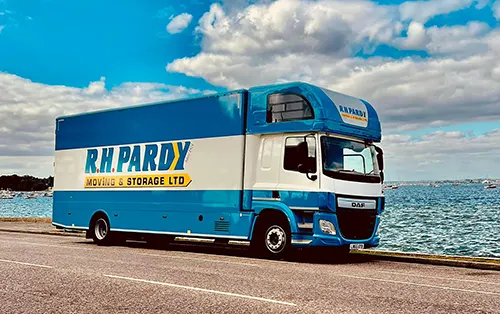
R.H. Pardy Moving & Storage has been helping people move from the Dorset area for over a century, and European removals from Dorset have been a core part of what the company does for many years.
As proud members of the British Association of Removers (BAR), Pardy operates to the highest professional standards in the industry, giving you genuine peace of mind that your move is in experienced and accountable hands.
From the initial survey through to unpacking at your new European address, the Pardy team handles the logistics, guides you through the paperwork, and keeps you informed throughout the process.
Whether you are heading to France, Spain, Portugal, or further afield, the team has the knowledge and the network to make the journey as smooth as it can be.
To request a free, no-obligation quote or simply to talk through your plans, you can reach the team on 01425 508 267 or 01202 152 120.
Alternatively, drop us an email at sales@pardyremovals.com.
You can also visit the full Pardy Moving & Storage website to explore service options, read about the team, and request a quote online.
Frequently Asked Questions About European Removals from Dorset
Do I need to be present when my belongings are collected and delivered?
You do not necessarily need to be present at both ends, though it is strongly recommended for at least one of them. At collection, being there means you can answer questions about fragile or high-value items, confirm the inventory, and make sure nothing is left behind. At delivery, having someone present ensures items go to the right rooms and any concerns are flagged immediately. If you cannot be there in person, a trusted representative with a signed letter of authority is the usual alternative.
Can I pack my own boxes for a European removal?
You can, and many people do, pack some or all of their own boxes to save on costs. However, it is important to understand that removal companies generally will not insure items they have not packed themselves. If a self-packed box arrives damaged, the contents may not be covered under the standard policy. For fragile, valuable, or sentimental items, professional packing is almost always the wiser choice on an international move where goods face a longer, more demanding journey.
What happens if my new property is not ready when my belongings arrive in Europe?
This is a genuinely common scenario and one that removal companies handle regularly. In most cases, your possessions can be held in secure storage at either the UK departure point or at a partner facility in the destination country while you wait for a completion date or tenancy to commence. It adds a line to the budget, but it is far preferable to rushing a completion or accepting a property that is not yet right. Raise the possibility of storage early in your planning conversations so it can be built into the logistics from the start.
Is my furniture covered if something gets damaged during the move?
A reputable removal company will offer or arrange removals insurance as part of the service, and for a European move, it is non-negotiable. Standard insurance typically covers loss and accidental damage during transit, but the details matter: check the excess, the per-item limits, and whether the policy covers the full replacement value or a depreciated figure. Some high-value items may require separate specialist cover. Ask your removal company to walk you through the options before you sign anything.
Can I ship my car as part of a European removal?
Yes, it is possible to include a vehicle in a European removal, though it comes with its own considerations. You will need to notify your insurer, check the destination country’s registration and documentation requirements, and be aware that some EU countries levy additional import taxes on vehicles based on age, value, and emissions. Post-Brexit, importing a car into an EU country is no longer as simple as driving it across and re-registering it. Talk to your removal company about whether they handle vehicle shipping directly or arrange it through a specialist partner.
How far in advance should I start planning a European removal?
The general rule of thumb is that more time is always better with an international move. For a European removal, starting the planning process at least three months before your intended departure date gives you enough runway to get quotes, arrange a survey, gather your documentation, and deal with the inevitable surprises that crop up in any house move. If your move coincides with a school holiday period, summer, or the end of a financial year, demand for removal slots increases and availability can tighten, so booking early protects your preferred dates.