



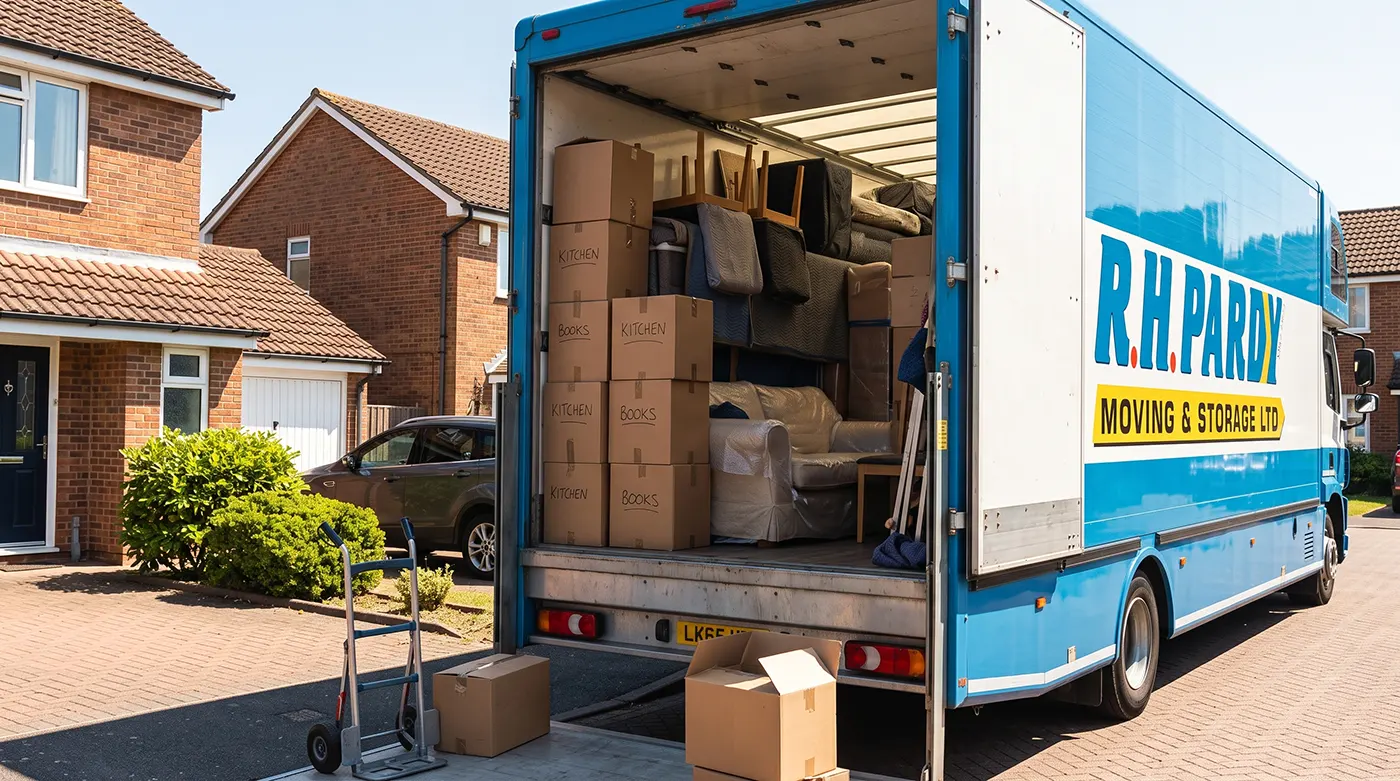
Have you got a home to clear but are unsure which service you need to help you: house clearance vs removals?
Ask most people to picture moving house, and they imagine a van, a team of movers and a lot of boxes. Ask them to picture a house clearance, and the image is usually a skip on the drive.
In reality, the two jobs overlap far more than people expect, and getting them confused is one of the most common (and costly) mistakes we see.
Here’s the simplest way to think about it. A removal focuses on what you are keeping. A house clearance deals with what you are letting go of. Most homes, especially ones lived in for decades, contain plenty of both.
At R.H. Pardy Moving & Storage, we have been moving Dorset households since 1924, and over a century we have watched countless families juggle a removal and a clearance at the same time, often while dealing with a bereavement, a downsize or a move abroad.
This guide explains the difference in plain English, covers the local rules that apply to house clearance Dorset and house clearance Bournemouth jobs, and shows you how to get the two working together rather than tripping over each other.
By the end, you should clearly understand what suits your situation best.
A Short Overview of This Blog
Not sure whether you need a removal company, a clearance firm or both? Here’s what each section covers, so you can jump straight to what matters to you.
- Removals and House Clearance in a Nutshell: the one question that tells you which service you need.
- What a House Clearance Actually Involves: what clearance firms do, and where your unwanted items really end up.
- What a Removal Company Does (And Doesn’t Do): why movers protect, transport and store, but don’t dispose.
- Bournemouth or Dorset Council? Why Your Postcode Matters: the two councils, their bulky waste services and local reuse charities.
- The Sofa Rule Most People Have Never Heard Of: why old, upholstered furniture now needs a fire label to be reused.
- Your Legal Duty When Waste Leaves Your Home: how to check a clearance firm and avoid a fine of up to £600.
- Four Dorset Situations Where You Need Both: probate, downsizing, moving abroad and merging two homes.
- Getting the Order Right: the sequence that keeps both jobs running smoothly.
- How R.H. Pardy Fits Into the Picture: our removals, packing, hourly and storage services.
- Frequently Asked Questions: quick answers to the questions we hear most.
Get the order and paperwork right, and a removal and a clearance can sit side by side without any drama.
Removals and House Clearance in a Nutshell
Every item in a home is heading to one of two places. Either it comes with you (or goes to a family member), or it leaves your life for good, whether that means a charity shop, a reuse project, a recycling centre, or, as a last resort, disposal.
If it is staying in the family, that’s a removal. The aim is to get it from A to B in the exact condition it left in, wrapped, protected, and insured.
If it is leaving because it’s no longer needed/wanted, that’s a clearance. The aim is to empty the space responsibly, legally, and ideally with as much as possible reused rather than thrown away.
A useful test when you walk round a room is simply to ask, ‘Would I be upset if this arrived scratched?’ If the answer is yes, it belongs with your removal.
If you would genuinely not mind, it probably belongs in the clearance pile.
What a House Clearance Actually Involves

A proper house clearance is far more than chucking things in a van. A good clearance firm will usually visit first to see the volume, then return on an agreed day to empty some or all of the property, including lofts, garages and sheds.
The better firms sort as they go. They pass on furniture and household goods in decent condition to charity shops or reuse projects, recycle metals and electricals, and dispose of only what is left.
Some will also deep clean once the property is empty, which is handy if you are selling or handing back keys to a landlord.
Pricing depends on volume, access and how much needs special disposal.
As a national benchmark, the British Heart Foundation’s house clearance service currently starts at £400, and its ability to resell items helps keep costs down.
Local firms across Dorset will quote on their own basis, so it is always worth getting two or three quotes.
What a Removal Company Does (And Doesn’t Do)

A removal company is built around one thing: looking after belongings that matter to you.
That means careful professional packing, furniture wrapping, dismantling and reassembly, safe loading and transport, and in many cases secure storage for anything that is not needed straight away.
What most removal companies are not is a waste service. Carrying household waste for disposal requires the right registration and paperwork, and a removal van is the wrong tool for that job.
So, if your plan is to ask the movers to ‘just take the rest to the tip’ on moving day, it is worth rethinking now rather than discovering the problem with a half-empty house and a deadline looming.
This is exactly why so many moves need both services.
The removal team handles the treasures, and a licensed clearance provider (or the council, or a charity) handles the rest.
Bournemouth or Dorset Council? Why Your Postcode Matters

Here’s a local quirk that catches people out. Dorset is split between two councils, and the rules and services differ depending on which side of the line your property sits.
If the home is in Bournemouth, Christchurch or Poole, you are dealing with BCP Council.
Its bulky waste collection service currently charges £41 for the first item and £11 for each extra one, with online bookings capped at ten items.
That works brilliantly for a single sofa and a bed, but it is not designed for a full house clearance in Bournemouth, where a private clearance firm is usually the better fit.
If the property falls under Dorset Council, which covers towns such as Wimborne, Ferndown, Wareham, Dorchester and Weymouth, large household items are handled through Dorset Council’s bulky waste arrangements with Dorset Reclaim.
This not-for-profit furniture reuse project has run since 1998, collecting furniture, electricals and household items across Dorset and west Hampshire and passing good pieces on to local families.
For good quality furniture, the children’s hospice charity Julia’s House also offers free collections of donated furniture, providing items that carry their fire safety labels.
That last detail matters more than most people realise, which brings us neatly to the next section.
The Sofa Rule Most People Have Never Heard Of

Since 2023, old sofas, armchairs and other upholstered seating are now treated differently from the rest of your furniture.
Many older pieces contain chemicals known as persistent organic pollutants (POPs), which were once used as flame retardants.
When upholstered seating becomes waste, it must be incinerated rather than landfilled or recycled.
There is a happier route, though. According to government guidance on reusing upholstered seating, a sofa or chair can still be passed on for reuse as long as it serves its original purpose, needs no more than minor repair, and complies with the law, which in practice means it carries its fire safety label.
So, before you clear a house in Dorset, check the labels on any sofas, armchairs and upholstered dining chairs.
A labelled, undamaged three-piece suite could go to a charity or a family member. One without a label is heading for the incinerator, and that usually costs more to dispose of.
Your Legal Duty When Waste Leaves Your Home
This is the bit nobody tells you about until it is too late.
As a householder, you have a legal duty of care to ensure your waste goes only to someone authorised to carry it.
If a ‘man with a van’ takes your old furniture and dumps it in a country lane, the waste can be traced back to you, and you will be responsible for any associated costs. Always do your due diligence checks before employing any random waste removal company.
Under government guidance on household waste duty of care penalties, councils can issue fixed penalty notices of up to £600 to householders who fail to take reasonable steps, and that is before any clean-up costs or court action.
Protecting yourself takes five minutes. Ask any clearance firm for their waste carrier registration number and check it on the Environment Agency’s public register of waste carriers.
Ask for a receipt or waste transfer note showing what was taken and where it is going. Be wary of anyone who knocks on your door offering to take things away cheaply, and note the vehicle registration if you hand anything over.
Four Dorset Situations Where You Need Both

Sometimes there is a need to use both the clearance and removal services such as:
- Clearing a loved one’s home. This is the most common reason families need both services together, and usually the most emotional. Treasured pieces may be heading to children and grandchildren around the country, while the rest of the house needs to be emptied before the property can be sold. If you are acting as an executor, the government’s guide to applying for probate explains the legal side, and it is wise not to clear or distribute anything until you are sure you have the authority to do so.
- Downsizing. Moving from a family home in Broadstone or Highcliffe to a coastal apartment or bungalow nearly always means the furniture won’t all fit. The removal takes the pieces you love, and the clearance deals with the spare bedroom suites, the garage and the loft.
- Moving abroad. Shipping costs are based on volume, so families relocating overseas from Dorset are often ruthless about what goes. A clearance before an international move can genuinely reduce shipping costs.
- Merging two homes. When couples move in together, or an elderly parent moves in with family, you suddenly have two of everything. The best of both households moves, and the duplicates are cleared or donated.
Getting the Order Right: Move First, Clear Second
The biggest headache we see is a clearance team and a removal team turning up on the same morning, each unsure which wardrobe belongs to whom.
A little planning avoids all of that, and this is the running order that tends to work best.
- Walk round with labels. Mark everything that is staying with coloured stickers, and agree with family members whois taking what before anyone books anything.
- Book a removal survey. A surveyor (or a video survey) can then price only the items that are coming with you, which keeps your quote accurate.
- Move or store the keepers first. Once everything you want is safely packed and loaded, or tucked away in storage, you won’t risk it being cleared by mistake.
- Then bring in the clearance. With only unwanted items left, the clearance firm can work quickly, and you can confirm nothing important remains.
- Leave a buffer. If you’re selling the property, leave a few days between the clearance and completion for a final check and a clean.
How R.H. Pardy Fits Into the Picture

At R.H. Pardy, we look after everything you keep, from the first survey to the last box.
We offer a range of services: free home surveys and video surveys, professional packing services, standard liability removals insurance up to £50,000, and secure containerised storage at our Christchurch base, protected by CCTV and a monitored alarm.
Storage is particularly useful when an estate or a downsize can’t be sorted in a single weekend. Family members can take their time deciding, while the most precious pieces sit safely in a container rather than in an empty house.
For smaller jobs, such as taking a dining table and a dresser to a relative in Bournemouth or across Dorset, our hourly removals service means you only pay for the time you need.
And, as members of the British Association of Removers, we work to strict professional standards, which you can read more about in our guide to using a BAR member for your move.
Whether you are planning a full house removal, a downsize, or a delicate family move after a loss, our team is happy to talk through timings and plan the move around your clearance.
To arrange a free, no-obligation quote, contact us online or give us a call today.
Frequently Asked Questions about House Clearance vs Removals
Can my removal company take my unwanted items to the tip?
No, this is very unusual. Most removal companies are not set up to carry household waste for disposal, so unwanted items should go to a registered waste carrier, the council’s bulky waste service or a charity collection.
How far in advance should I book my removal?
Six to eight weeks is a sensible target, particularly in spring and summer and at the end of the month, when Dorset removal diaries fill up quickly. If a clearance is also involved, book both services at the same time so the dates work together.
Should I declutter before or after my removal survey?
Ideally, declutter before, or at least decide what is staying, before the surveyor arrives. That way, your quote is based only on the items you are actually moving, which can noticeably reduce the cost.
Can you store furniture while we sort out a relative’s estate?
Yes. Short- or long-term storage gives families time to decide without pressure, and you can deliver items to different addresses later.
Can I leave things in drawers and wardrobes on moving day?
Light clothing can usually stay in drawers, but pack heavy items, books, liquids, and breakables separately. It is also worth checking every drawer before a clearance, as paperwork and valuables are often found tucked away.
How much does a removal cost in Dorset?
It depends on the volume of belongings, the distance, access at both properties and any extras such as packing or storage. A free survey is the best way to get an accurate figure.
Are my belongings insured during the move?
A reputable remover will include liability cover as standard and offer additional options for high-value items. Always ask what is covered before you book.
Can you move just a few items to a family member?
Yes. Hourly or part-load removals are ideal for passing heirlooms, furniture, or a piano on to relatives, whether they live across Bournemouth or elsewhere in the UK.


