




Are you looking for removals to France from Dorset?
If you’re swapping Dorset for the La belle vie (the good life) in France, you’ve come to the right place!
There’s a moment, usually somewhere between the second glass of Burgundy on a French holiday and the estate agent’s listing you keep bookmarking, when moving to France stops feeling like a dream and starts feeling like a plan.
And if you’re based in Dorset, you’re in one of the best-placed corners of England for making that leap.
The ferry ports of Poole and Bournemouth are practically on your doorstep, Paris is little more than three hours by Eurostar, and the rolling hills of Normandy are closer to Blandford Forum than Manchester is.
Turning that dream into a departure date takes a whole lot of planning, of course.
From getting your belongings across the Channel without a customs headache to understanding what the whole thing will actually cost, this guide is written for you: the Dorset mover with France firmly on the horizon, heading into 2026 with purpose and a passport.
Let’s get started.
A Quick Guide to Moving from Dorset to France – Topics Covered
Our article explains the practical side of relocating from Dorset to France, from removals costs and customs paperwork to visas, storage, property prices, and preparing for life across the Channel.
• Why Dorset Is Perfectly Positioned for a Move to France
Learn why Dorset’s ferry connections and South Coast location make moving to France far more straightforward than many people expect.
• What Removals to France Actually Cost in 2026
A realistic look at pricing, what affects your quotation, and why surveys are essential before booking.
• Understanding Post-Brexit Customs Rules
Find out what paperwork is needed, which belongings qualify for tax exemptions, and how to avoid customs complications.
• Visas, Residency and Healthcare Explained
A simple overview of long-stay visas, residency permits, healthcare registration, and settling legally in France.
• Why Storage Can Make International Moves Easier
Discover how secure storage helps when property purchases, renovations, or moving dates do not align perfectly.
• French Property Prices and Rental Trends in 2026
Explore popular expat regions, average property prices, and why many UK movers choose to rent before buying.
• Insurance and Protecting Your Belongings
Understand why specialist removals protection matters when transporting furniture and valuables overseas.
• Everyday Realities of Life in France
Helpful insights into French paperwork, village life, utilities, local culture, and adapting to daily life abroad.
• Your 2026 Moving Checklist
A practical step-by-step timeline covering everything from booking removals to customs paperwork and address changes.
• How RH Pardy Can Help with Your Move
Information about RH Pardy’s removals, storage, customs support, and international moving services from Dorset to France.
Starting a completely new chapter abroad requires careful consideration and good preparation. Experienced removals support can make your move to France feel far less daunting.
Why Dorset to France Is a Route Worth Celebrating

Moving to France from Dorset has a certain geographical elegance to it.
You’re not embarking on a cross-country trek before you’ve even left England. Poole Harbour, one of the world’s largest natural harbours, sits at the heart of the county and is a short drive from Brittany Ferries’ busy Poole to Cherbourg service, a route that has carried generations of British expats and their furniture to a new life in France.
The Brittany Ferries Poole to Cherbourg crossing typically takes around four and a half hours on the overnight sailing, which means your removal lorry can be in Normandy before most people have finished breakfast.
That kind of proximity makes the logistics genuinely manageable, and it gives your chosen removal company a clean, well-trodden route to work with.
Popular French destinations for Dorset movers include the Charente, the Dordogne, Brittany, Normandy and the Loire Valley, all areas with well-established British communities, strong transport links, and a quality of life that continues to draw people south and east each year.
What Does It Actually Cost? Removals to France from the UK in 2026

Let’s talk money, because it’s almost always the first question asked.
The cost of removals from the UK to France varies considerably depending on how much you’re transporting, where in France you’re headed, and what level of service you choose.
As a rough guide for 2026, a full household removal from Dorset to northern France for a three-bedroom property typically falls somewhere between £3,000 and £6,000, depending on volume and access at both ends.
A move to central or southern France, where the driving distance increases substantially, will naturally push toward the higher end or beyond.
Smaller relocations, perhaps a one or two-bedroom property or a part-load service, can come in considerably lower.
Volume is the biggest pricing factor, followed by destination, access conditions at the French property (narrow village lanes and steps can add time and complexity), and whether you opt for a professional packing service.
Specialist items such as pianos, antiques or ride-on garden machinery may attract additional charges, so always mention them when requesting a quote.
For full transparency on what’s included, request a tailored quote from RH Pardy Moving & Storage, who can walk you through exact figures for your specific move.
A pre-move survey is a must and key to an accurate quotation. We can arrange for our surveyor to visit in person or via video link. It is free of charge and quickly followed by our obligation-free quotation.
Navigating Post-Brexit Customs: What You Need to Know Before You Go
Since the UK’s departure from the EU, moving personal belongings to France involves customs formalities that simply didn’t exist before 2021.
It sounds daunting, but it’s very manageable once you understand the process, and a reputable removal company will guide you through the paperwork at every step.
The key document you’ll need is a detailed inventory of everything being transported, with an estimated value for each category of goods. We will prepare the inventory for you as we pack.
You’ll also need evidence that you’ve been a resident in the UK for at least twelve months prior to your move, and confirmation that the items are genuinely for personal use rather than resale.
The good news is that UK nationals transferring their primary residence to France can bring household goods free of import duty and VAT, provided they apply for the Franchise de droits et taxes exemption through French Customs.
This relief applies to goods owned and used for at least six months before the move date. Brand-new or recently purchased items, including that gorgeous new sofa, may not qualify for the exemption.
Prohibited and restricted items are worth knowing about in advance.
Fresh food, certain plant species, and firearms all have specific regulations. A professional international removal company will provide a clear guidance sheet covering what can and cannot be transported in your consignment.
FIDI has a handy downloadable French customs regulations guide you can use as a reference.
Residency, Visas and the Long-Stay Process for British Nationals

Post-Brexit, British citizens no longer have automatic rights to live and work in France.
If you intend to stay for more than ninety days, and of course you will if you’re relocating permanently, you’ll need a long-stay visa (Visa de Long Sejour, VLS-TS) before leaving the UK.
Applications are made through the French Embassy or VFS Global and must be processed before you depart.
The visa type depends on your circumstances: retirees typically apply as non-economically active residents, while those planning to work or run a business need a different category.
Take a look at the Experts for Expats website for an in-depth explanation of all the visas available to UK expats.
Once in France, the visa is converted into a Carte de Sejour (residency permit) by applying to your local prefecture within the first year of arrival.
Healthcare access follows residency registration. France operates the PUMA system (Protection Universelle Maladie), which, once you’re registered and either contributing or receiving a pension, gives you access to the French health network.
Carrying a GHIC card during your transition period acts as a useful bridge.
Rest assured, the French healthcare system consistently ranks among the finest in the world, which is one of the undeniable draws of the move.
Storage Solutions: The Bridge Between Two Countries

Not everyone arrives in France with all loose ends neatly tied up.
Perhaps your French property purchase has hit a delay, or you need time to renovate before you can fully move in, or there are unforeseen delays on the UK side beyond your control.
This is where a well-chosen storage arrangement makes all the difference, and it’s something many Dorset movers overlook until rather late in the day.
RH Pardy’s secure, flexible storage service works particularly well for international moves.
Your belongings can be collected from your Dorset property on your original schedule, kept safely in purpose-built storage facilities, and then dispatched to France once your completion date is confirmed.
This is especially practical if you’re selling your UK home before your French property is ready, removing the pressure of needing both transactions to align perfectly.
Storage is also a sensible option for items you’re not certain about taking immediately and want sent later.
Many movers find that a few months in rented or part-furnished accommodation in France helps them understand what they actually need in their new home before committing to the full shipment.
With RH Pardy, your belongings stay with us from collection to delivery in France. No third-party involvement makes the process much smoother.
The French Property Market in 2026: A Snapshot for Dorset Buyers

When you are ready, buying a property is the final act of cementing your new life in France.
The French property market is in a genuinely good place for buyers right now.
Sales volumes rose by eleven per cent in the year to February 2026, while prices have moved only modestly at around one per cent nationally.
Buyers currently have real negotiating power, with properties selling at roughly eight per cent below asking price on average.
For Dorset movers, the popular relocation regions offer outstanding value compared to home.
The Dordogne averages around 1,844 euros per square metre for houses, Brittany sits at around 2,625 euros, and the Loire Valley comes in at just over 2,100 euros.
Even factoring in notaire fees of around seven to eight per cent on top of the purchase price, the contrast with Dorset property values is considerable.
Browsing SeLoger, the French equivalent of Rightmove, is a good way to gauge values in your target area before a viewing trip.
Homes with lower energy ratings are attracting discounts of up to twenty-five per cent in some regions, which is worth knowing if renovation projects appeal.
If you’d prefer to rent first and get the measure of an area before committing to a purchase, the French rental market is well organised and flexible.
Furnished tenancies with a minimum one-year term are widely available in most expat-friendly regions, and many Dorset movers find that a year of rented living in France is the best research they have ever done.
This Ibanista article will help you navigate the buying process, while for those intending to rent for a while, the French-Property website offers some very useful information regarding the process.
Removals Insurance: Don’t Cross the Channel Without It

Your furniture and belongings carry both sentimental and financial value, and even the most careful removal team can encounter an unexpected complication on a long international journey.
Comprehensive removals insurance (called MoveProtect in the industry), provides genuine peace of mind from loading to delivery and should never be skipped on a cross-border move.
Standard home contents insurance rarely covers goods in transit across international borders, making specialist cover essential.
RH Pardy’s MoveProtect cover is specifically designed for this purpose, covering your belongings from the moment they’re collected at your Dorset address to the point they’re safely delivered in France.
As proud BAR (British Association of Removers) members, RH Pardy also provides access to a payment protection scheme, giving you an added layer of financial security throughout the booking process.
A Few Things Nobody Tells You Before You Move to France
The paperwork is one chapter of the story. The softer side of relocating, the neighbours, the local markets, and the administrative quirks is quite another.
Here are a few honest observations from those who’ve made the journey before you.
France still runs largely on paper and in-person processes. Even in 2026, many administrative procedures require certified copies of documents, wet signatures, and visits to the mairie (town hall). Keep a folder of certified copies of your passport, birth certificate, and marriage certificate if applicable.
The Angloinfo France community is a brilliant resource for day-to-day practical guidance from British expats already living in France.
A little French goes a very long way, not just linguistically but in terms of how warmly you’re received. Stumbling attempts at the language are appreciated far more than you might expect.
The local market, the boulangerie and the cafe tabac are the social glue of French village life and making the effort to engage with them early builds goodwill quickly.
On the practical side, French homes use 220V electricity with Type E sockets, so British appliances will need adaptors, and some may not be compatible at all.
Many rural French properties also have a fosse septique (septic tank) rather than mains drainage, requiring annual servicing and registration with the local authority.
The 2026 Checklist: Moving to France from Dorset Step by Step

Getting organised early is the single biggest advantage you can give yourself.
Here’s a practical timeline tailored for anyone making the move from Dorset to France this year.
- Six months or more before you move: register your intended relocation with the French consulate, begin your research into residency requirements, open a French bank account, and arrange a survey if you’re purchasing property. Registering with your local French commune online ahead of time can also smooth the administrative process considerably.
- Three months before departure: book your removal company and confirm your international removal dates. Start compiling your inventory, sort through what you genuinely want to take versus what to sell, donate or store, and begin notifying UK organisations of your address change. Setting up a Royal Mail redirection service for at least twelve months is well worth doing.
- In the final four weeks: confirm your ferry crossing or road route with your removal company, gather all customs documentation, inform HMRC of your departure, register with a French GP (medecin traitant) and ensure all prescription medications are documented.
- On moving day itself, photograph your belongings and ensure you bring your copy of the loading inventory with you. Key documents and valuables are best kept with you personally rather than in the removal lorry.
Ready to Make the Move? RH Pardy Moving & Storage Is Here for You
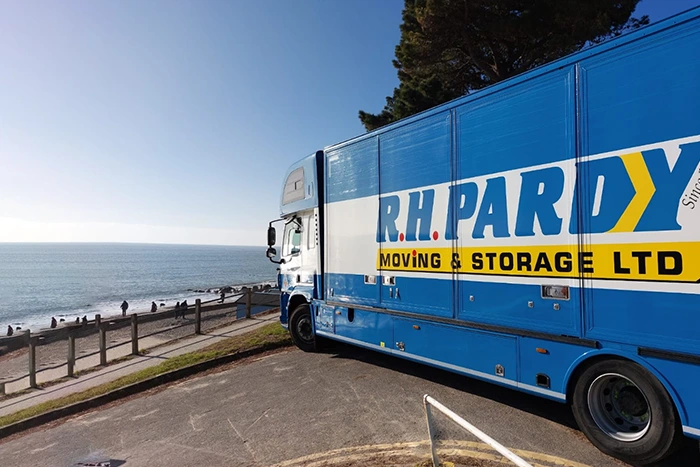
RH Pardy Moving & Storage Ltd has been helping families and individuals across Dorset and the surrounding area relocate for over a century. Based in Christchurch, the team is ideally placed to serve movers across the whole of Dorset, including Bournemouth, Poole, Wimborne, Ferndown, Blandford Forum and Bridport.
As proud members of the British Association of Removers (BAR), RH Pardy operates to the very highest professional standards in the industry. Their experienced team handles every aspect of removals to France from the UK, including door-to-door collection and delivery, full or partial packing services, customs documentation support, and flexible storage. The company holds an outstanding 4.8-star Google rating from over 160 verified customer reviews.
Whether your move is a few weeks away or you’re still in the very early stages of planning, RH Pardy is delighted to discuss your options and provide a free, no-obligation quote tailored to your situation.
For your free-of-charge, no-obligation pre-move survey, get in touch today.
Email: sales@pardyremovals.com
Free Quote: pardyremovals.com/contact-us
Frequently Asked Questions: Removals to France from Dorset
Q: How long does a removal from Dorset to France typically take?
A: The journey time depends largely on your destination in France. A removal to Normandy or Brittany from Dorset, using the Poole to Cherbourg ferry, typically takes one to five days door to door (destination dependent), including loading, the sea crossing and delivery. Moves to the Dordogne, Charente or southern France generally take two to three days. Your removal company will give you a specific timeframe based on your precise route and access conditions.
Q: Can I have my car transported in the removal lorry?
A: In most cases, no. Removal lorries are configured for household goods and are not licensed to carry passenger vehicles. However, your removal company can advise on separate vehicle transport services, or you may choose to drive your car independently to France and arrange European breakdown cover for the journey.
Q: Do I need to be present at the French property when my belongings arrive?
A: It is strongly advisable to be present, or to have a trusted person there on your behalf. You will need to check items against the inventory, sign the delivery note, and direct the removal team to the correct rooms. If access timing is an issue, discuss this with your removal company in advance as a storage-and-deliver-later arrangement may be available.
Q: What if my French property purchase is delayed after my UK home is sold?
A: This is one of the most common scenarios in international moves, and a well-run removal company will have a solution ready. RH Pardy’s secure storage facility in Dorset means your belongings can be collected from your UK property on schedule, stored safely, and then delivered to France once your completion date is confirmed. This removes the pressure to have both property transactions align perfectly.
Q: Are my belongings insured during an international removal to France?
A: Standard home insurance policies rarely cover goods in transit internationally, so arranging specialist removals insurance is essential. RH Pardy offers a comprehensive insurance option for international moves that covers your goods from collection through to final delivery. Always review the policy details carefully, including the excess and claims procedure, before confirming your booking.
Q: What items cannot be included in a removal lorry going to France?
A: Several categories of items cannot travel in a standard international removal. These include flammable or hazardous materials such as paint, aerosols, and camping gas; fresh food and perishables; plants and soil due to phytosanitary regulations; certain medications without a supporting prescription; and any firearms or weapons. Your removal company will provide a full prohibited items list when you confirm your booking, so there are no surprises on moving day.